What is cooperative care?

Cooperative care is training animals to willingly be a part of their own care. It can look like training a horse to voluntarily participate in deworming, injections, putting on a halter, and much more. The possibilities are limited only by the trainer's creativity. It's also the current focus of my research.
Why does it matter?
Cooperative care and horses' voluntary participation matter for a few reasons: human and animal safety, the welfare of the horse, and ease of care.
Anyone who works with horses regularly knows that they can be dangerous, especially if we put them in a situation where they feel threatened. We often use restraint (even if it's just holding them with a halter and lead rope) to get medical care done. This can cause unnecessary stress. It also adds a safety risk for the handler, because horses who feel trapped are more likely to bite, kick, strike, rear, bolt, or trample their handler. For higher-risk horses, cooperative care also adds the option to work with protected contact, which is just having a barrier like a fence between the handler and the horse. This can almost entirely eliminate safety risks.
Even if your horse does not become dangerous during vet visits, restraining them for procedures may be causing them stress. Even horses who are completely still during care may be experiencing the "freeze" response to fear rather than the fight or flight responses we're more familiar with.
Lastly, creating a positive experience for a horse makes it easier to get care procedures done. You don't have to restrain or struggle with your horse because they voluntarily participate, meaning it keeps your stress levels low and makes the procedure more efficient.
What animals can benefit from cooperative care?
Any animal can benefit from cooperative care. While there isn't a lot of peer-reviewed research yet on cooperative care for horses, there are a lot of trainers who practice it successfully. It's a great option for horses who have had bad experiences in the past because it helps build positive associations.
Some people argue that positive reinforcement training isn't safe with horses because they are so large and food-motivated. They argue that it creates dangerous horses. This is not true, although it is important to train correctly to avoid creating unwanted behaviors, just like conventional negative reinforcement training.
Cooperative care is used in zoos worldwide for animals from lions to capybaras to penguins. If we can train grizzly bears to offer their paws for blood draws and elephants to offer their feet for trims, we can certainly train horses to participate in care.
Ways to use cooperative care with horses
The opportunities are seemingly endless for cooperative care. As long as a trainer can figure out the steps to shape a behavior, they can train almost anything. Some common uses for it include:
Putting on fly masks
Haltering
Hoof care
Deworming
Injections
Stationing (standing still on something like a mat)
This can also be a great foundation for other behaviors
Nerve blocks
Blood draws
Veterinary exams
Trailering
While cooperative care and positive reinforcement are incredible, with lots of possible applications, it's important that the trainer has impeccable timing, clear criteria, and a very good understanding of learning theory. If you want to learn more about learning theory, check out my post on it here.
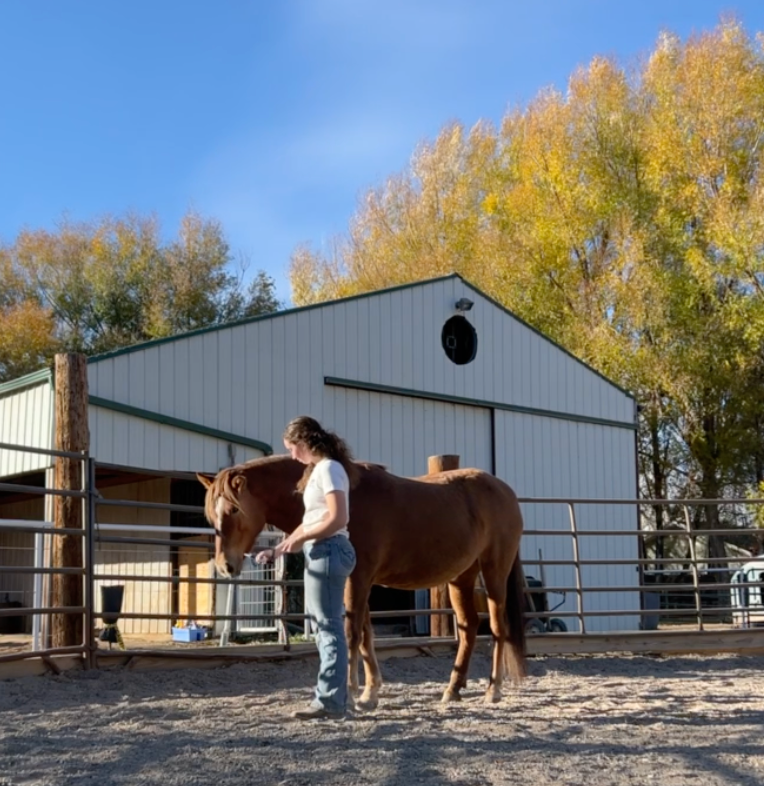
Mustang mare, Floofy, willingly participating in being
dewormed after just 35 minutes of cooperative care training.


Comments